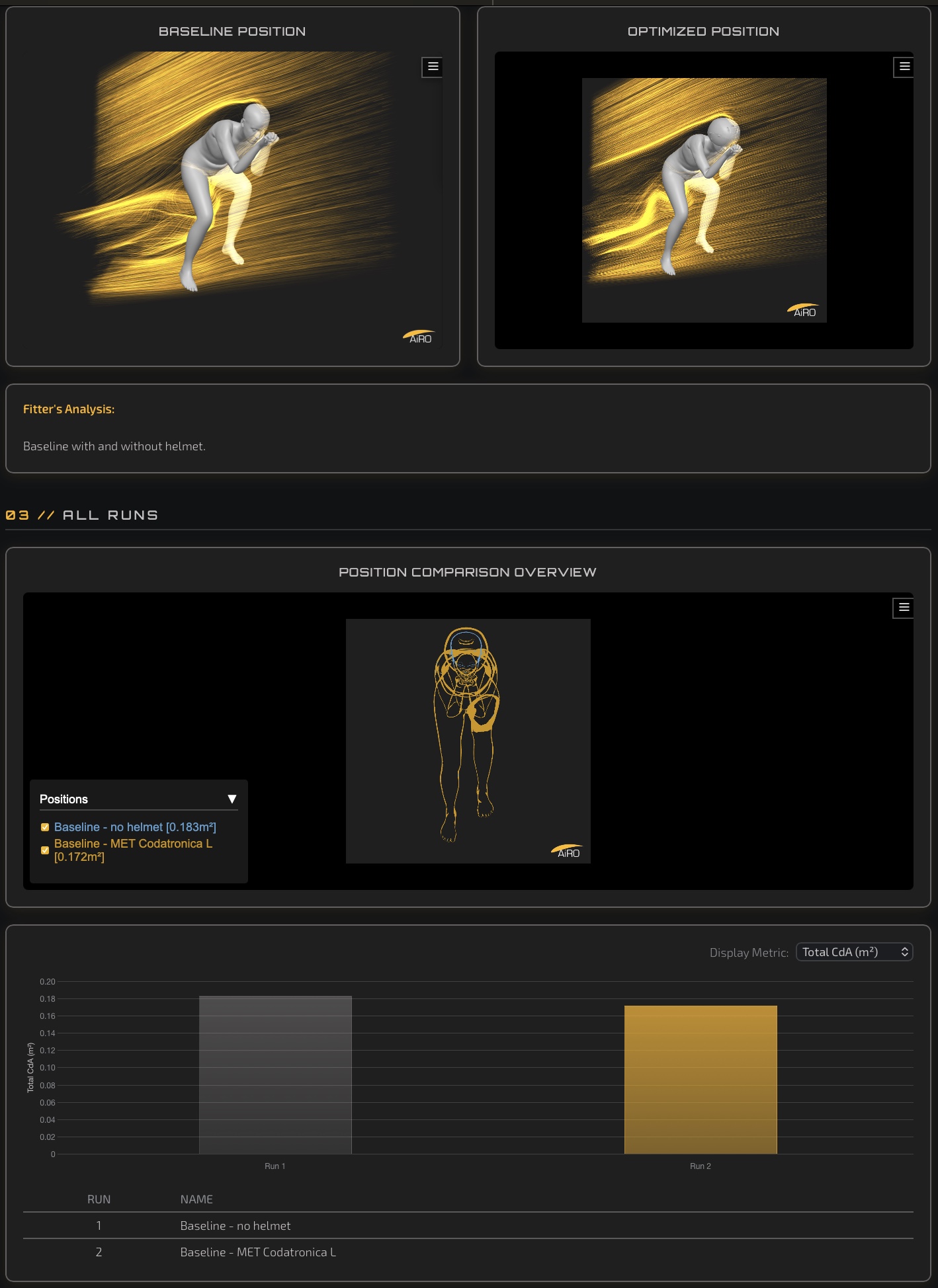
What does it mean by a riders CdA?
In simple terms: “A” is your effective frontal area; “Cd” is how cleanly air flows around you and the bike. The product is CdA - your “how hard it is to push through air” number.
This service is about choosing the setup that produces the best CdA outcome, while staying comfortable and sustainable.
Is this service remote only?
Remote is the default for the standard CFD packages. FIT-CFD is the in-person option at Southfork Cycles: position check first, then a 2-hour CFD block, with follow-up runs used afterwards.
What is the up to date Menu of helmets?
We can do anything from a shortlist to the full roster. A typical “shootout” is ~10 helmets, then re-test the top few if needed.
Premium Aero gives room for deeper helmet testing and tie-breakers; if you want the full roster, just tell us and we’ll quote the runs needed.
New helmets are being added regularly.
Current line up (21.10.2026):
ABUS Timeshifter (Narrow & Wide visor)
Ekoi Pure Aero (M-L)
Ekoi R-Aero (M)
Giant Rivet M Visor
Giro Aerohead
Giro Aerohead II (S-M-L same shell)
HJC Adwatt 1.5 (S,M,L sizes)
Kask Mistral
Lazer Volante KinetiCore (M)
MET Codatronca (L)
MET Drone Wide Body II (M)
Oakley Velo TT (S-M-L)
POC Cerebel (M)
POC Tempor
Rudy Project The Wing (S-M)
Rudy Project Wingdream (S-M)
Specialized TT 5
Specialized Evade 3
Sweet Protection Redeemer
Uvex Race 8 (56-58cm)
Uvex Ultimate Race TT (59-61cm)
Van Rysel RCR-X 2 (M/L Classic Visor & M/L Cut Visor)
How big are the gains really?
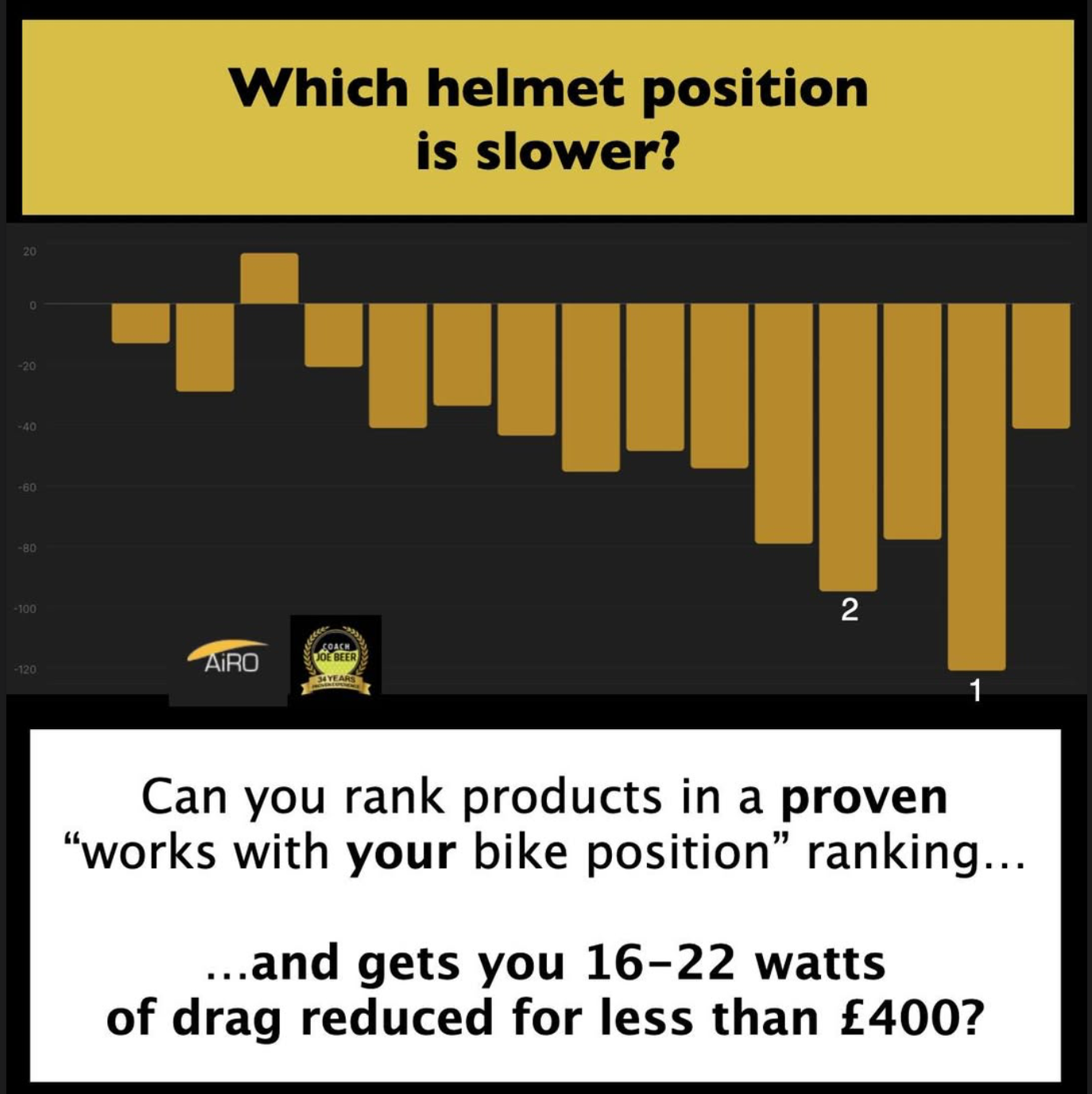
Many athletes see meaningful improvements—often around ~20-25W at race speed when you combine position + helmet + tidy details.
Your results depend on baseline position, speed, constraints and what you’re willing to change.
What do I need to prepare?
Your position measurements, a few photos/video angles, race target, your current helmet details.
You will be sent a link to a webpage where you fill in all your measurements and requirements.
What is Deep Sweep 30?
Deep Sweep 30 is for riders who are already in the AiRO system and already have a strong position. Instead of making only large obvious changes, we systematically move through small increments around your current best setup — for example elbow width, elbow height, hand height, reach/fore-aft and head/neck position. We first identify which directions improve or worsen drag, then refine around the promising zones and use the final runs to test useful combinations. The aim is to find gains that can remain hidden when a position already looks fast.